What Goes Under a Paver Patio, and Why It Matters More Than the Pavers
Two patios can look identical on day one and behave completely differently by the third winter, and the difference is underground.
October 14, 2026 · 3 min read
The pavers are the part you see
Walk onto a finished patio and everything you notice is on the surface: the color of the stone, the pattern, the crisp edge where it meets the lawn. None of that is what keeps the patio flat ten winters from now. The ground under it does that work, and most of it is buried the day the job wraps up.
That's why two patios that look the same in a photo can behave nothing alike. One stays tight and level. The other grows a dip by the downspout, a ridge near the house, and joints that open up every spring. The difference is almost never the paver itself. It's what was done below it.
Excavation comes first
A paver patio starts as a hole. The crew strips the sod and the topsoil, because topsoil is full of organic material that rots, settles and holds water. It's the last thing you want a patio resting on. The dig goes down to firm, undisturbed ground and is cut to the shape of the patio, with extra room around the edges so the base can extend past the finished stone.
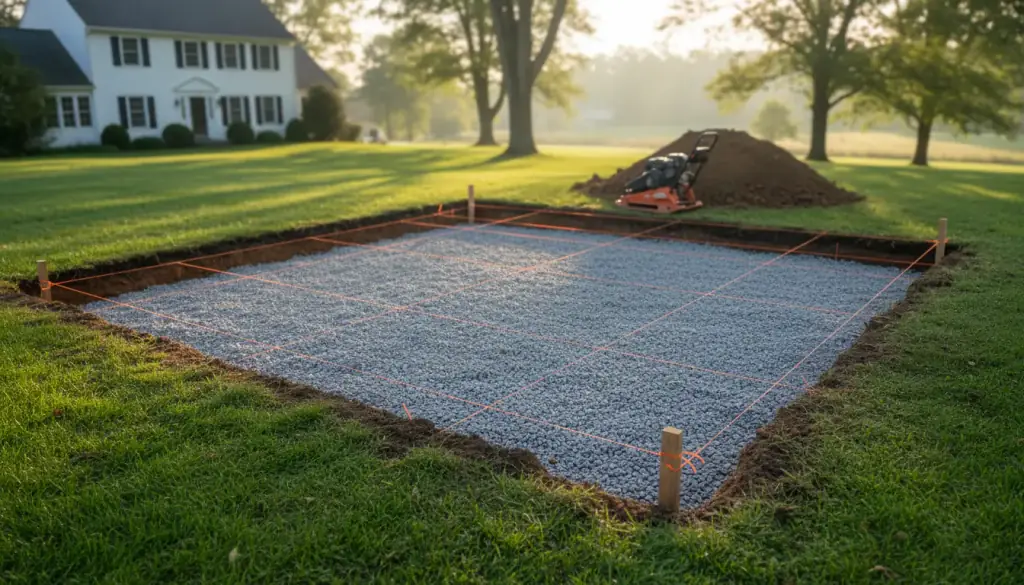
The photo with this article shows that stage: a rectangular cut in a lawn, wooden grade stakes, orange string lines, a plate compactor beside the spoil pile. It's an illustration of the trade, not a specific TJM Yard Enhancing job. But it shows the part homeowners rarely see. The stakes and string aren't decoration. They set the slope, so rain has somewhere to go once the stone is down.
Compacted crushed stone does the heavy lifting
After the dig, crushed stone goes in as the base, spread in layers and compacted with a plate compactor before the next layer goes on. Crushed stone is angular, so the pieces lock against each other. Round gravel and loose soil don't. A good base spreads the weight of furniture and foot traffic over a wide area, lets water drain through, and stays put when the ground moves.
Skip the compaction and the base settles under use, and the pavers settle with it. You won't see it for a season or two, which is exactly why it's a tempting shortcut.
Pennsylvania adds a second reason to care. The ground here freezes and thaws over and over each winter. Water that sits in or under a base expands as it freezes and pushes upward, then drops when it thaws, and not always evenly. A base that drains well gives that water a way out. A base built over soft or soggy ground with no drainage gives it nothing to do but lift your patio.
The bedding course and the edge
On top of the base sits a thin bedding course that's screeded smooth, and the pavers are set into it. Its only job is to give each stone an even bed. It isn't there to make up for a base that's out of shape. Piling on extra bedding material to fill a low spot is a classic shortcut, and it compresses unevenly, so the low spot comes back.
Then there's the edge. Pavers want to creep outward under load. An edge restraint around the perimeter holds the whole field in place, and the joints are filled with jointing material that locks the stones together. Without a solid edge, the outer rows drift, the joints open, and the patio loosens from the outside in.
What a skipped step looks like later
- Puddles that hang around after rain: the slope was too flat, or the base settled low.
- Ridges and dips: uneven compaction, or too much bedding material under some stones.
- Open joints and drifting edges: weak or missing edge restraint.
- A patio that rises in spring and sinks by summer: water working into a base that can't drain.
Fixing any of these usually means lifting the pavers and rebuilding underneath, which is far more work than building the base properly the first time.
Questions worth asking any contractor
Ask what the base is made of, how it gets compacted, and where the water goes when it rains. A contractor who answers in plain language has probably done it the right way many times. TJM Yard Enhancing is a Certified ICPI Installer (that's the Interlocking Concrete Pavement Institute), works with Techo-Bloc Pro products, and uses only in-house staff, so the people who dig the base are the same people who set the stone.
If you're planning a patio in Quakertown or Coopersburg, call TJM Yard Enhancing at (610) 346-6867 for a FREE estimate. The installation comes with a three-year warranty on workmanship.
TJM Yard Enhancing, (610) 346-6867
Call (610) 346-6867More articles
Permeable or Non-Permeable Pavers: Picking the Right One for Your Patio, Driveway or Pool
Both are interlocking pavers, but they handle rain in opposite ways, and that changes what's underneath.
Why Retaining Walls Lean and Bulge, and What a Certified SRW Installer Does Differently
A wall that holds back soil is fighting water and weight every day, and the part you can't see decides whether it wins.