Why Retaining Walls Lean and Bulge, and What a Certified SRW Installer Does Differently
A wall that holds back soil is fighting water and weight every day, and the part you can't see decides whether it wins.
October 14, 2026 · 4 min read
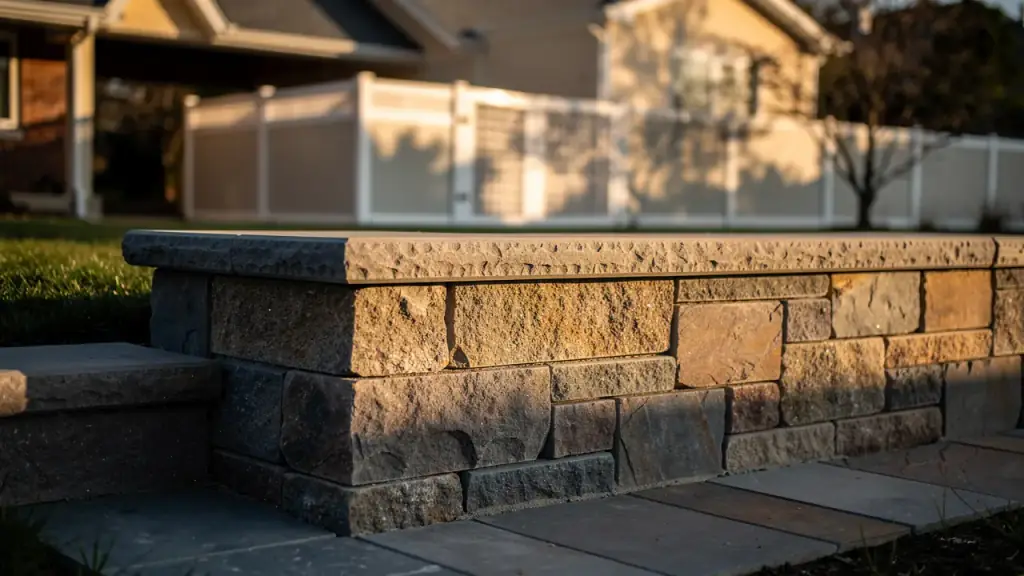
A retaining wall is a working wall
A garden wall holds up itself. A retaining wall holds up a hillside. Behind those stacked stones sits a mass of soil that wants to move downhill, and when it rains, that soil gets heavier and the water pushes harder. Over a Pennsylvania winter, freezing and thawing adds even more force.
A segmental retaining wall, or SRW, is built from interlocking blocks stacked without mortar. Done right, it flexes slightly and keeps standing for a long time. Done wrong, it starts to lean, bow outward in the middle, or step out at the top. Most failures come from the same short list of causes.
Water is the usual culprit
Soil full of water is much heavier than dry soil, and the water pressing against the back of the wall adds to the load. A wall that was designed for dry soil can bulge after a wet spring. The standard answer is drainage built into the wall: a column of clean crushed stone directly behind the blocks, and a perforated drain pipe at the bottom that carries water out the end of the wall instead of letting it build up.
Look above the wall, too. Downspouts, a sloping lawn or a driveway that drains toward the wall all dump water into the soil behind it. Sending that water somewhere else takes load off the wall before it ever reaches the blocks.
When that drainage is left out, or the stone is replaced with the dirt that came out of the hole, water has nowhere to go. It collects behind the wall, the pressure rises, and the blocks start moving. A wall can look perfectly fine for a few years and then change quickly after a wet season.
The base and the backfill
Every course of blocks rests on the one below it, so the first course matters most. It sits on a trench of compacted crushed stone, set level, because anything off at the bottom gets magnified as the wall climbs. A wall stacked on loose or uncompacted material will settle, and a settling wall rotates forward.
SRW blocks are also built to lean back slightly into the slope as the wall rises, which is part of how a stack of unmortared blocks resists the soil pushing on it. Get the setback wrong, or let the first course wander out of line, and the wall starts out already working against itself.
The soil and stone placed behind the wall matter just as much. Backfill goes in a layer at a time and gets compacted as it rises. Dump it all in at once and it settles later, pushing on the blocks as it goes.
Geogrid and taller walls
On taller walls, or walls holding up something heavy, the blocks alone aren't enough. Geogrid is a strong, flexible mesh laid between courses and run back into the compacted soil behind the wall. It ties the wall to the earth behind it, so the soil and the blocks act as one reinforced mass instead of a stack of stones leaning on a slope.
A tall wall, or one holding back a slope that carries a driveway or a building, is a different category of job from a low garden wall. It's reasonable to ask any installer how they plan for that, and to expect a clear explanation of what goes behind the blocks.
What a certified installer brings
TJM Yard Enhancing is a Certified SRW Installer and a Certified ICPI Installer. A certification doesn't replace judgment about your particular slope, but it does mean the installer has been through formal training on how these walls are built. TJM's own materials say their certified installers receive continuing education, and that the company attends the Techo-Bloc show every year to keep up with the products they install.
They also work only with in-house staff and no subcontractors, so the crew that dug the trench and set the first course is the crew that finishes the wall.
Signs your wall is already in trouble
- Blocks leaning forward, or the face bowing out in the middle.
- Gaps opening between courses, or blocks stepping out of line.
- Water seeping through the face after rain, or soil washing out at the bottom.
- Cracks in a patio or driveway running alongside the top of the wall.
A small bulge usually keeps growing, so it's better to have someone look at it early.
If you're planning a new retaining wall, or you're worried about an old one in Quakertown or Coopersburg, call TJM Yard Enhancing at (610) 346-6867 for a FREE estimate. Their workmanship is covered by a three-year warranty.
TJM Yard Enhancing, (610) 346-6867
Call (610) 346-6867More articles
What Goes Under a Paver Patio, and Why It Matters More Than the Pavers
Two patios can look identical on day one and behave completely differently by the third winter, and the difference is underground.
Permeable or Non-Permeable Pavers: Picking the Right One for Your Patio, Driveway or Pool
Both are interlocking pavers, but they handle rain in opposite ways, and that changes what's underneath.